Which BCBA Practice Test Is Closest to the Real Exam?
A comprehensive clinical breakdown comparing BCBA practice exams across Pearson VUE timing, 6th Edition domain weights, scenario ambiguity, AI rationales, and 4-hour cognitive stamina.
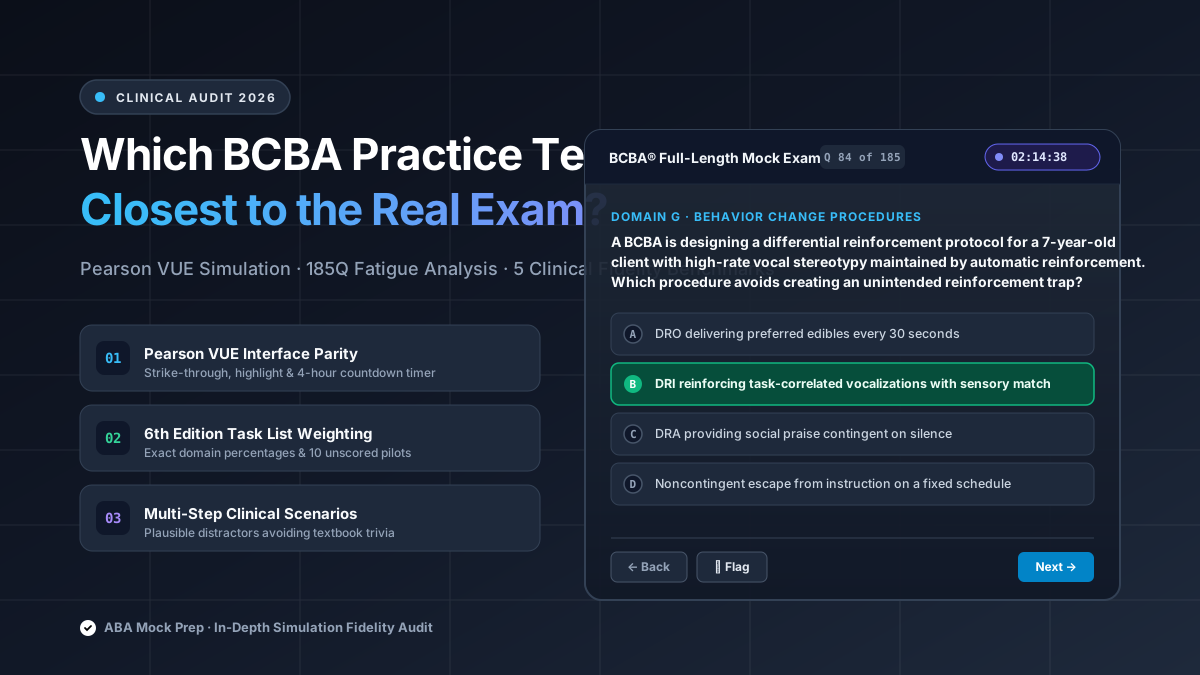
The Gap Between Practice Mocks and Exam Day Reality
Which BCBA practice test is closest to the real exam? On raw format alone, ABA Wizard and StudyABA come closest. Both use 185 questions, a strict four-hour limit, and the 6th Edition Test Content Outline (TCO), which puts them ahead of most alternatives before you even evaluate question content.
However, format is only one dimension of a useful mock exam, and it is not the primary factor that predicts whether you will pass. The real BACB examination tests clinical judgment in ambiguous scenarios where all four answer options appear defensible, and that is precisely where many commercial practice tests fall short, regardless of how many questions they contain.
This comparison evaluates the market using five objective criteria:
- Format and timing enforcement
- Domain weighting fidelity
- Question style and clinical ambiguity
- Rationale depth and distractor deconstruction
- Predictive readiness value
Platforms like ABA Mock Prep were designed specifically to close the gap between surface-level format replication and the complex clinical reasoning the actual examination demands. By the end of this breakdown, you will know which BCBA practice test fits your individual preparation stage and exactly how to use it.
Key Takeaways
- Format is the Floor, Not the Ceiling: Full-length (185-question), timed simulations are the single best proxy for exam-day pacing and mental endurance. Shorter drill sets are useful for targeted learning, but they do not replicate the cognitive stamina demands of a 4-hour test.
- Domain Weighting Matters: The 6th Edition TCO distributes 175 scored questions across nine content domains at strict percentages. A mock that skews toward basic measurement while under-representing personnel supervision miscalibrates your preparation.
- Question Style is the Real Differentiator: Scenario-based items requiring multi-step clinical judgment are far harder to write and significantly more predictive than rote definition recall.
- Rationales Should Teach, Not Just Confirm: The highest-yield mocks explain in precise behavioral terms why every wrong answer fails, rather than simply stating which letter is correct.
- Vendor Pass-Rate Claims Are Marketing Estimates: No independently validated, peer-reviewed data links commercial mock scores to real BCBA pass rates.
- Domain-Level Accuracy Beats Total Score: Use your section-by-section breakdown rather than an overall percentage to steer your final study weeks.
What "Closest to the Real Exam" Actually Means
The real BCBA examination provides 185 questions and four hours, which works out to approximately one minute and eighteen seconds (78 seconds) per question. Any mock exam that does not enforce a full-length, timed environment leaves a critical readiness gap around pacing, cognitive fatigue, and late-test attention decay. That is the minimum bar a practice exam must clear before anything else matters.
Domain weighting is the second layer. The BACB 6th Edition Test Content Outline distributes 175 scored questions across nine distinct content areas:
- Domain B (Concepts & Principles): 14% (25 questions)
- Domain G (Behavior-Change Procedures): 14% (25 questions)
- Domain F (Selecting & Implementing Interventions): 12% (21 questions)
- Domain E (Ethics): 11% (19 questions)
- Domain H (Personnel Supervision & Management): 11% (19 questions)
- Domain D (Behavior Assessment): 10% (18 questions)
- Domain C (Measurement & Experimental Design): 10% (18 questions)
- Domain I (Assessing & Monitoring Supervision): 9% (16 questions)
- Domain A (Behaviorism & Philosophical Foundations): 5% (9 questions)
(Plus 10 unscored pilot questions distributed randomly across the exam).
A mock test that front-loads measurement definitions and ignores personnel supervision will push your study time in the wrong direction.
The hardest dimension to replicate is question style. The real exam rarely asks "What is extinction?" Instead, it presents a client scenario, describes what a BCBA observes during session, and asks what the analyst should do first, with four plausible options that all sound defensible to a novice reader. Most practice tests get the format right and miss this nuance entirely.
Format and Timing: The Top 5 Options Compared
The table below compares the five most commonly referenced options using the criteria that directly drive exam-day readiness.
| Provider | Questions | Time Limit | 6th Edition TCO Aligned | Scenario-Based Items | Rationale Depth | Price |
|---|---|---|---|---|---|---|
| ABA Wizard | 185 | 4 hours | Yes | Moderate | Per-item feedback | 29/mock; 59 for 3 |
| StudyABA | 185 (incl. 10 pilot) | 4 hours | Yes | Moderate to strong | Detailed; domain diagnostics | 50/mock; 100 Gold |
| Pass the Big ABA | 185 | 6 months access (2 attempts) | Yes | Strong applied focus | Deep applied rationales | $129/Big Mock |
| BACB (Pearson VUE Tutorial) | Interface tutorial only | Not a scored mock | N/A | N/A | None | Free |
| ABA Mock Prep | 185 | 4 hours | Yes, exact domain weighting | Clinical vignette-first | AI-driven, distractor-level explanations | $29/month; free 3-day trial |
ABA Mock Prep was built with the explicit mission of closing the gap between static textbook preparation and the dynamic clinical reasoning demanded by Pearson VUE test centers. Questions are authored around authentic clinical vignettes, weighted strictly to 6th Edition domain percentages, and calibrated for the subtle distractor traps encountered on test day.
Which Platform Has the Deepest Question Rationales?
A strong rationale does far more than confirm the correct letter. It explains:
- Why the correct answer fits the specific clinical scenario.
- Why each of the three distractors fails in behavioral terms.
- Which 6th Edition content outline task governs the item.
- How to spot the underlying decision rule when it appears under a different clinical presentation.
StudyABA is one of the most documented options for 6th Edition alignment, featuring questions reviewed by experienced BCBAs and tested with candidate cohorts. Its domain-level score reports provide actionable diagnostics.
Pass the Big ABA Exam consistently earns praise for applied reasoning in its rationales, emphasizing scenario-based items over pure recall. However, static answer keys cannot adapt to individual learner blind spots.
ABA Mock Prep's AI Exam Coach operates on an interactive feedback model. When you miss a question, the system does not simply show an answer key. It isolates the governing behavioral principle, details exactly why your selected distractor was a near-miss trap, and links the item to targeted practice drills. For candidates struggling with persistent confusion (such as MO vs. SD or Negative Reinforcement vs. Positive Punishment), this iterative feedback loop accelerates clinical judgment.
Do Mock Exam Scores Actually Predict Whether You'll Pass?
StudyABA claims that more than 99% of candidates who pass its mock exams pass the actual BCBA examination. However, that figure is vendor-reported and self-selected without published denominator data, follow-up control groups, or repeat-tester adjustments. It is an encouraging indicator, but not a peer-reviewed statistical guarantee.
ABA Wizard reports average mock scores between 70% and 77% across its exams, but explicitly notes that it does not track individual pass/fail outcomes.
What the Empirical Data Shows:
Consistent high performance across multiple full-length, timed mocks provides a reliable readiness signal. An isolated high score on an untimed, relaxed attempt provides little predictive value.
In an internal 2026 data analysis from ABA Mock Prep covering over 1,600 completed full-length mock attempts:
- Average Score: 41.8%
- Median Score: 35.0%
- Candidates Scoring ≥ 80%: 11.2%
This distribution underscores that realistic 185-question mock exams are demanding. Rather than searching for a single magic composite score, treat your domain-level accuracy as your primary compass. Scoring 85% on Measurement and Data Display alongside 58% on Selecting and Implementing Interventions shows you exactly where your preparation must focus over the final two weeks.
What Trips Candidates Up Between Mock Tests and Exam Day
User reports and exam post-mortems reveal four persistent traps:
- The "Missing Information" Trap: The real exam intentionally presents lean vignettes where background context is incomplete by design. Candidates must identify what is clinically required without making unstated assumptions. Mocks that provide overly signposted information teach candidates to rely on clues that will not exist at Pearson VUE.
- Difficulty Calibration Extremes: Mocks that run unrealistically hard generate debilitating pre-exam anxiety; mocks that run too easy produce false confidence. Balanced calibration is vital.
- Workstation Disorientation: Practicing exclusively on a smartphone does not prepare candidates for the physical reality of a desktop workstation with a countdown clock, a question navigation matrix, and keyboard shortcuts.
- The 4-Hour Cognitive Endurance Drop: Fatigue sets in around question 120. Pacing errors, misreading stems, and second-guessing spike dramatically during the final 90 minutes. Taking at least two full-length, 4-hour timed simulations is non-negotiable for building mental stamina.
How to Turn Your Mock Score into a 2-Week Sprint Study Plan
Once you complete a full-length simulation, use your domain breakdown to execute a targeted two-week review sprint:
Week One: Diagnostic and Weak-Spot Remediation
- Day 1: Sit for one full-length, 185-question timed mock (4 hours uninterrupted). Record your domain percentages.
- Days 2–3: Review every incorrect response and flagged item. Document the behavioral principle and distractor failure reason in a personal error log.
- Days 4–7: Allocate 80% of daily study time to your two lowest-scoring domains (e.g. Domain F and Domain H), completing 20–30 focused practice questions per day.
Week Two: Verification and Stamina Rehearsal
- Day 8: Complete a second full-length timed mock to verify domain improvement.
- Days 9–11: Review errors; conduct rapid-fire fluency drills on Cooper definitions and formulas.
- Day 12: Final full rehearsal under strict test-day conditions: no phone, no pauses, 4-hour countdown timer.
- Days 13–14: Rest and light ethics review. Avoid taking new tests immediately prior to exam day.
The Bottom Line
On format and 6th Edition TCO alignment, ABA Wizard and StudyABA are established commercial tools. Pass the Big ABA Exam provides deep applied rationale depth at a higher price tier.
For candidates who need clinical vignette fidelity, AI-powered distractor explanations, exact 6th Edition domain weighting, and integrated performance analytics, ABA Mock Prep was built to provide an all-in-one simulation environment.
Use practice exams as diagnostic systems rather than confidence checks. The tools that teach you why you missed an item are the ones that ensure you pass on your first attempt.
Frequently Asked Questions
Is the Pearson VUE tutorial a scored practice exam?
No. The Pearson VUE tutorial is an interactive walkthrough designed to familiarize candidates with keyboard shortcuts, highlighting, and the question flagging interface. It does not provide practice questions or a scored result.
Are shorter practice question sets ever useful for BCBA prep?
Yes. Shorter sets (20 to 40 questions) are excellent for targeted domain drilling and rapid concept reinforcement. However, they cannot replace full-length 185-question simulations, which are essential for conditioning 4-hour cognitive stamina and pacing.
How many full-length timed mocks should I take before exam day?
Candidates should complete at least two, and ideally three, full-length 185-question timed simulations under strict exam conditions before their test date.
Should I trust vendor pass-rate claims as proof I will pass?
No. Vendor pass-rate claims (such as "99% pass rate") are self-reported marketing figures that lack peer-reviewed validation and denominator transparency. Consistent scores across multiple unmemorized, timed mocks and balanced domain-level mastery remain the most reliable signals of exam readiness.
Master of Science in Applied Behavior Analysis (National University), active RBT with 3+ years of clinical fieldwork, and current BCBA candidate. Creator of ABA Mock Prep, bridging standardized board testing with real clinical practice.
Ready to test your speed on questions like this?
Jump into our timed board simulator with 1,000+ realistic scenario questions, 4-hour mock exam pacing, and instant AI tutor explanations for every distractor.