Common Clinical & Exam Pitfalls: Prompt Dependency, Shaping vs. Chaining & Measurement Mix-Ups
Five everyday mistakes that quietly undermine RBT competency checks, clinic skill acquisition, and certification scores—plus clear decision rules to separate shaping, chaining, stimulus fading, and latency vs. IRT.
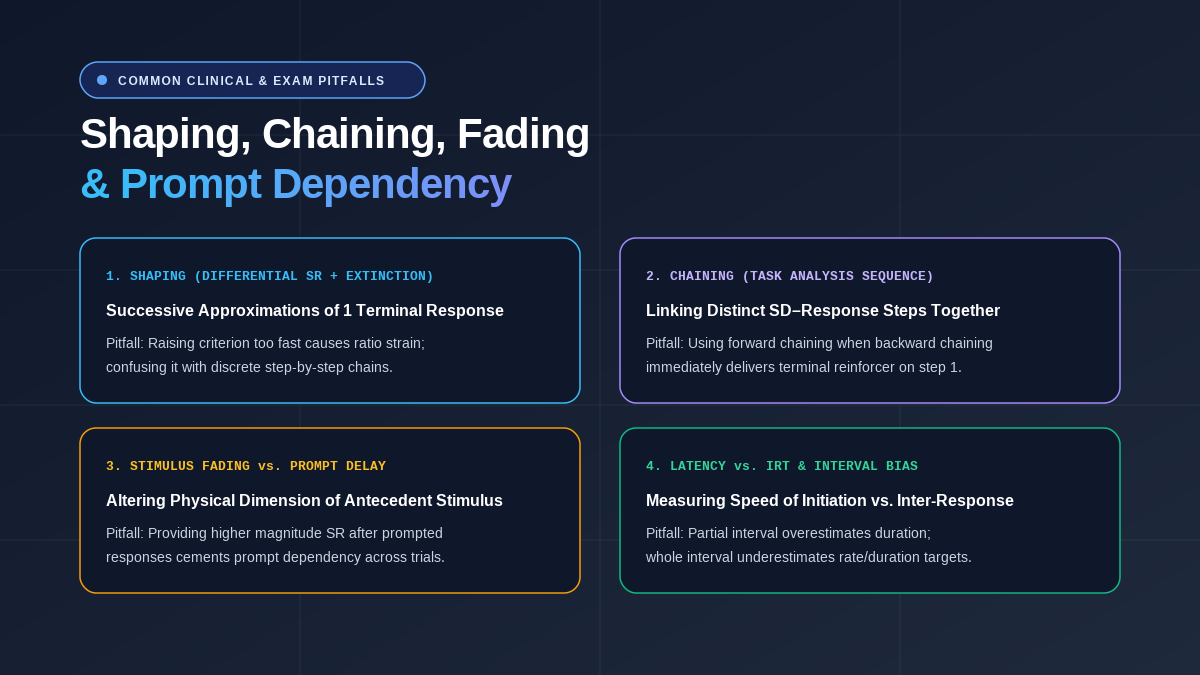
Why Everyday "Routine" Habits Cause So Many Missed Questions
Not every tricky board question uses exotic terminology. In fact, a massive share of missed items on RBT and BCBA exams—and frequent errors noticed during RBT competency assessments—come down to everyday teaching habits where two close clinical procedures get blurred together.
Let's unpack the five most common clinical and exam mix-ups so you eliminate easy lost points.
Pitfall 1: Accidentally Building Prompt Dependency
Imagine teaching a child to greet peers cleanly, and every time the technician immediately gives a partial vocal prompt ("Say hi!"), the child gets full enthusiastic praise and immediate access to his favorite sensory swing. Later, when the child responds independently, the rushed technician gives a casual "nice" and moves on.
- What went wrong: Delivering equal or higher magnitude reinforcement after prompted responses than independent responses violates differential reinforcement of independent responding, rapidly locking in prompt dependency!
- The rule: Prompted trials earn brief praise or corrective continuation at most; save highest quality, highest magnitude reinforcement exclusively for unprompted independent responses, and systematically apply prompt fading / progressive time delay.
Pitfall 2: Confusing Shaping With Behavior Chaining
| Dimension | Shaping | Behavior Chaining |
|---|---|---|
| Core Mechanism | Differential reinforcement of successive approximations + extinction of earlier forms | Linking discrete SD–response steps via a Task Analysis sequence |
| How Many Behaviors? | One single terminal behavior gradually refined (e.g., clearer vocal sounds or longer waiting) | Multiple distinct steps joined into one routine (e.g., washing hands or tying shoes) |
| What Gets Extinguished? | Earlier, rougher approximations stop receiving reinforcement once the next criterion hits | Previously mastered steps continue functioning as conditioned reinforcers / SDs for the next step |
| Classic Pitfall | Jumping criterion steps too far too fast triggers ratio strain and emotional outburst | Running Forward Chaining on an easily frustrated learner when Backward Chaining delivers the final preferred outcome right on step 1! |
Pitfall 3: Calling Time Delay "Stimulus Fading" (and Vice Versa)
Candidates constantly pick "stimulus fading" simply because an instruction got faded out. Look closely at what changes:
- Response Prompt Fading (and Time Delay): Changing what the therapist does (moving from full physical to partial physical to gestural, or waiting 0s -> 3s -> 5s before helping).
- Stimulus Fading: Gradually modifying a physical dimension of the antecedent instructional stimulus itself across trials—for example, progressively lightening dotted tracing lines or shrinking bold color cues on a sight-word card while keeping the response identical.
Pitfall 4: Backwards Discontinuous Interval Choices
When clinics measure behavior using 2-minute intervals across a 30-minute circle time, choosing the wrong sampling rule flips your clinical conclusion:
- Partial-Interval Recording (PIR): Score
Yesif the behavior happens at any moment during the interval -> overestimates total duration (and mildly underestimates rapid burst counts). Best used for problem behavior reduction where you want conservative sensitivity to any occurrence. - Whole-Interval Recording (WIR): Score
YesONLY if the behavior persists across the entire interval from start to finish -> underestimates behavior. Best reserved for duration-increase skill targets like sustained on-task reading! - Momentary Time Sampling (MTS): Score ONLY at the exact moment the timer beeps -> avoids continuous watching while remaining unbiased across long intervals, though low-rate spikes between beeps can be missed.
Pitfall 5: Mixing Up Latency, Duration & Interresponse Time (IRT)
Three stopwatches, three completely different questions:
- Latency: Time from presentation of the SD / instruction until initiation of the response ("Put on your coat" -> starts picking up coat = 14 seconds). Goal when reducing procrastination!
- Duration: Total elapsed time from response start to response end (holding a toothbrushing posture = 95 seconds).
- Interresponse Time (IRT): Elapsed gap from the END of one response to the START of the next instance of that same response (gap between two bites of food to prevent rapid stuffing, or pause between hand-raises).
Practice Exam Scenario (RBT & BCBA Domain C/G)
Scenario: An occupational-focused ABA program teaches a 6-year-old boy to button his jacket independently. Because the child cries whenever multiple steps remain unfinished, the BCBA instructs the technician to complete steps 1 through 4 smoothly for him, then prompt only the final pull-up of the top button so the child immediately finishes the coat, receives praise, and heads outside to the playground. Over subsequent sessions, the technician prompts one earlier step each week until the full sequence runs independently. Which procedure and rationale best match this intervention?
- A. Total-task chaining, because the client attempts all four earlier steps independently during every single trial.
- B. Shaping, because buttoning represents tighter successive motor approximations of one vocal-motor target.
- C. Backward chaining, because the learner completes the final step first and immediately contacts the natural terminal reinforcer (going outside).
- D. Stimulus fading, because the jacket buttons gradually become smaller across teaching weeks.
Breakdown & Distractor Rationale
- A is incorrect: Total-task chaining requires the learner to attempt every step in sequence on each trial, not letting the therapist perform earlier steps beforehand.
- B is incorrect: Dressing a jacket links multiple distinct component behaviors together from a task analysis, rather than differentially refining one single behavior topography while extinguishing older approximations.
- C is correct: In backward chaining, the trainer completes all prior steps and teaches the last step first so the client contacts the natural terminal reinforcer immediately, cutting escape frustration.
- D is incorrect: The physical dimensions of the buttons are not being modified across trials.
Test your speed across these everyday traps using Free Practice Questions or build custom decks in our Study Hub.
Master of Science in Applied Behavior Analysis (National University), active RBT with 3+ years of clinical fieldwork, and current BCBA candidate. Creator of ABA Mock Prep, bridging standardized board testing with real clinical practice.
Ready to test your speed on questions like this?
Jump into our timed board simulator with 1,000+ realistic scenario questions, 4-hour mock exam pacing, and instant AI tutor explanations for every distractor.