Unusual Case: The 3-Tap Door Ritual — Adventitious Chains, Explanatory Fictions & Multiple Control
When a 7-year-old tapped the door three times and spun a pencil before every session, observers called it 'rigid anxiety.' Behavioral analysis uncovered accidental VI escape delays—plus a hidden verbal operant trap.
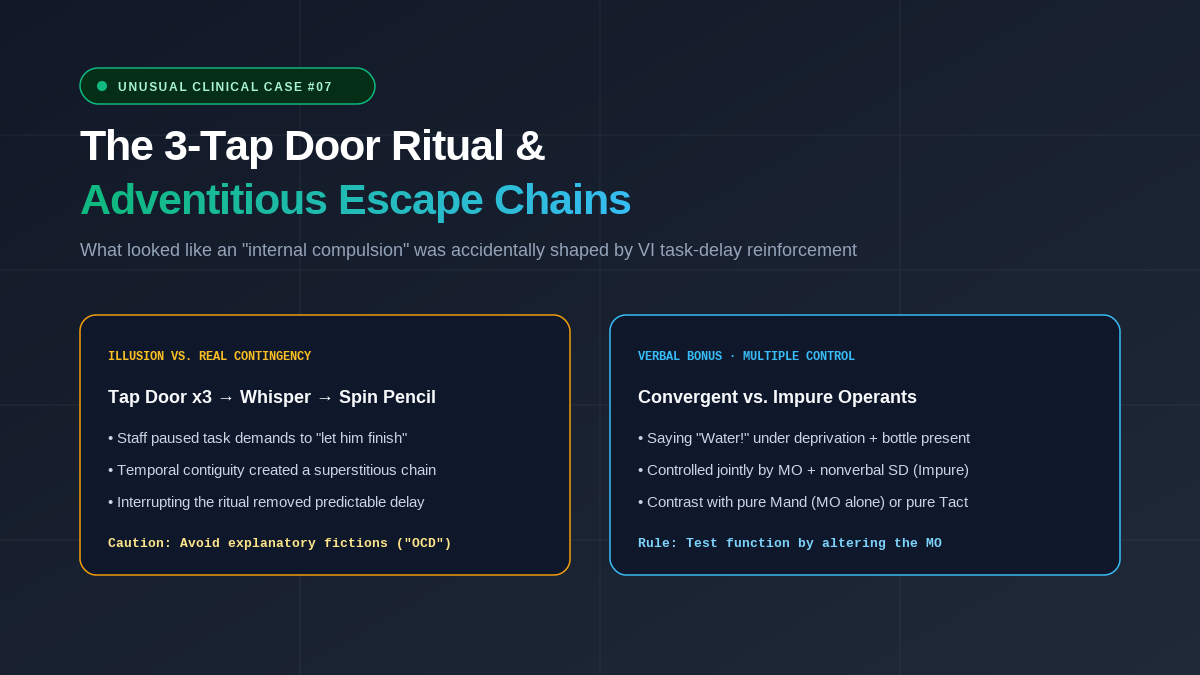
The "OCD Ritual" That Was Actually Accidentally Shaped on the Floor
One of the defining strengths of Applied Behavior Analysis (Domain A: Philosophical Underpinnings & Domain B: Concepts) is rejecting explanatory fictions—circular mentalistic labels that describe a behavior twice instead of locating its real environmental controller.
Consider this curious clinic case involving a 7-year-old client, Mateo:
- The Unusual Behavior: Upon entering therapy room B every morning, Mateo walked straight to the doorway, tapped the frame cleanly three times, whispered "check ready," sat down, and spun a yellow pencil once across the table before answering his first trial.
- When It Broke: Whenever a substitute RBT picked up the pencil prematurely or blocked the door tap to start discrete-trial teaching (DTT) faster, Mateo screamed, swiped materials off the desk, and refused instruction for 15+ minutes.
Staff notes quickly filled with mentalistic explanations: "Mateo shows rigid OCD-like anxiety and an internal need for predictability before tolerating transitions."
Wait—before accepting "internal anxiety" as the cause, look at what happened every single morning in the 30 seconds after the ritual.
Unmasking the Accidental Contingency: Adventitious Reinforcement
When the supervising BCBA reviewed video probes of morning arrival across four RBTs, she discovered a remarkably simple environmental schedule:
- Six weeks earlier, during an accidental 20-second pause while an RBT unpacked stimuli, Mateo happened to tap the doorframe and spin a pencil right before the RBT smiled and waited patiently.
- Each time Mateo engaged in the sequence afterward, regular therapists politely stepped back and waited an unpredictable 15 to 45 seconds before presenting non-preferred demands ("Let's let him finish getting settled first").
- Neither the taps nor the pencil spin had to cause the delay logically—yet temporal contiguity on a variable interval (VI) delay schedule accidentally strengthened an adventitious chain (also called superstitious behavior)!
- Why did blocking the pencil explode into aggression? Blocking a ritual that reliably produced temporary escape from demands acted like abruptly dropping scheduled delay reinforcement to zero without teaching an alternative transition skill, triggering an aggressive escape response.
Bonus Twist in the Same Room: Multiple Control (Impure Mand-Tact)
During the same video review, a second diagnostic error surfaced on Mateo's vocal communication graphs:
Whenever Mateo arrived cold and thirsty after recess and spotted an open juice cup sitting on the shelf while looking right at the RBT, he yelled, "Cup!"
- RBT A scored it as a pure Tact because the physical cup was visibly present on the shelf.
- RBT B scored it as a pure Mand because Mateo reached eagerly after drinking nothing during outdoor play.
Who was right? Actually, calling it a pure mand OR a pure tact misses how verbal behavior works in daily clinics. When a response is jointly controlled by an active Motivating Operation (thirst/deprivation) AND a nonverbal discriminative stimulus (the visible cup), it illustrates convergent multiple control—specifically an impure mand-tact!
| Term | Real-World Trigger in This Case | Why Exam Teams Misclassify It |
|---|---|---|
| Explanatory Fiction | Blaming "rigid need for control" instead of delay contingencies | Circular reasoning that halts environmental functional assessment |
| Adventitious Chain | 3-tap + pencil spin shaped by non-contingent escape delays | Looks intentional or cognitive despite resting purely on accidental contiguity |
| Pure Tact | Controlled solely by a nonverbal stimulus + generalized conditioned SR | Cannot explain why frequency spikes under specific deprivation |
| Impure Mand-Tact | Controlled jointly by MO (thirst) + visible object (cup) | Both sources converge simultaneously on one spoken topography |
Clinical Fix: Replacing Superstition Without Power Struggles
Once the environmental contingencies were clear, the BCBA dropped the "rigid OCD" narrative and changed two variables in 48 hours:
- Eliminated accidental demand delays: On arrival, the RBT greeted Mateo immediately at the threshold with a brief high-preference micro-choice ("Blue marker or green timer while we sit down?") leaving zero gap for adventitious chaining.
- Taught an explicit Functional Communication Response (FCR): If Mateo wanted 30 seconds to unpack or catch his breath before desk tasks, asking "Quick break first, please" cleanly earned a 20-second delay—no tapping or pencil-spinning required.
- Trained RBTs to track MO vs. SD separately when collecting verbal operant data so mand probes tested with the item temporarily out of sight.
Practice Exam Scenario (Measurement, Concepts & Verbal Operants)
Scenario: Before starting math flashcards every day, a student clicks his tongue twice, adjusts his left sleeve, and takes a deep breath. Data review reveals that for the past month, whenever he performed this sequence, teachers routinely paused instruction for 25 seconds believing he needed "sensory grounding." Today, an aide interrupts his sleeve adjustment immediately with a demand, and the student flips his chair. Which concept BEST accounts for why the 3-step sequence originally formed and persisted?
- A. Respondent higher-order conditioning triggered by math worksheets.
- B. Adventitious (superstitious) reinforcement maintained by accidental delays to task demands.
- C. Behavioral contrast caused by stricter rules in the afternoon speech room.
- D. Automatic positive reinforcement because clicking always produces enjoyable oral feedback.
Breakdown & Distractor Rationale
- A is incorrect: Somatic startle or respondent conditioning does not organize an arbitrary multi-step voluntary sequence maintained by teacher pausing.
- B is correct: Because the sequence happened to occur immediately prior to teachers delaying aversive demands, accidental temporal contiguity shaped and maintained the superstitious ritual chain via negative reinforcement (demand delay).
- C is incorrect: Behavioral contrast requires inverse changes in behavior frequency across two distinct schedules/settings when reinforcement changes in one setting—nothing indicates a rate increase triggered by another room tightening reinforcement.
- D is incorrect: If the sequence were maintained purely by automatic reinforcement regardless of teachers, interrupting the pause before demands would not depend on escape-delay contingencies.
Build fluent discrimination across Domain A, B, and G concepts inside our AI Semantic Flashcards & Study Decks or launch an RBT Practice Exam.
Master of Science in Applied Behavior Analysis (National University), active RBT with 3+ years of clinical fieldwork, and current BCBA candidate. Creator of ABA Mock Prep, bridging standardized board testing with real clinical practice.
Ready to test your speed on questions like this?
Jump into our timed board simulator with 1,000+ realistic scenario questions, 4-hour mock exam pacing, and instant AI tutor explanations for every distractor.