AI Session Notes, Medicaid '100% Error' Audits & Telehealth Rollbacks: What Clinicians Get Wrong in 2026
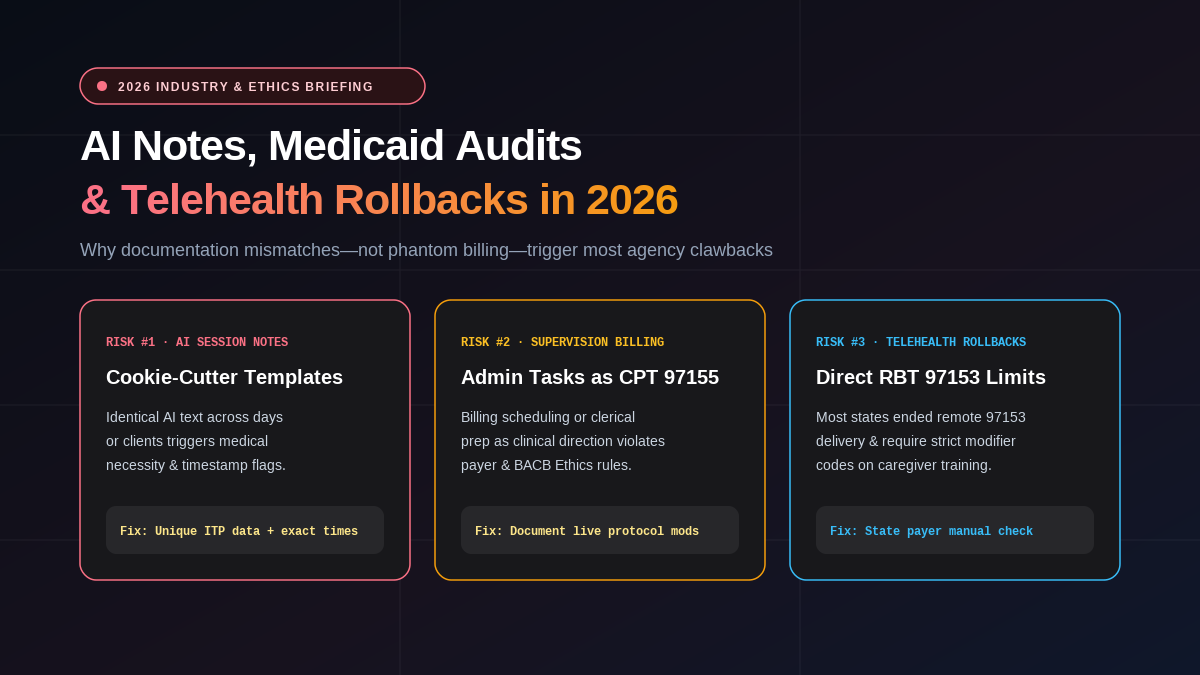
Federal and state audits this year show most clawbacks come from cookie-cutter AI clinical notes, clerical billing under CPT 97155, and dropped telehealth coverage for direct RBT therapy—plus how these issues show up on Domain I.
Why Regulatory Scrutiny Reached an All-Time High in 2026
Across state Medicaid agencies and federal oversight offices, ABA therapy reimbursement surged dramatically over the last four years—expanding rapidly beyond USD 10 billion annually. In response, state payers and federal inspectors rolled out targeted retrospective audits in 2025 and 2026 that caught entire clinic networks off guard.
Notice the surprising pattern in recent audit findings: the overwhelming majority of improper payment findings were NOT caused by "phantom billing" for sessions that never happened. They were caused by clinical documentation failures.
In several sampled state audits, nearly every audited enrollee-month contained at least one technical discrepancy capable of triggering full financial recoupment (clawbacks). And almost every one of those real-world documentation mistakes maps directly onto Domain I (Ethical & Professional Conduct) and Domain H (Supervision) on your certification exam.
Three Real-World Failures Happening Across Clinics Right Now
1. Cookie-Cutter AI Session Notes (The Copy-Paste Trap)
To ease paperwork fatigue, many agencies introduced AI note assistants in 2025–2026 that auto-draft narrative summaries for RBTs and BCBAs. The compliance problem begins when staff click Approve without editing individualized clinical details:
- Identical phrasing across consecutive dates or clients: Auditors compare notes longitudinally. Five sessions containing nearly identical AI-generated sentences ("Client tolerated transitions with minimal prompting and responded positively to contingent reinforcement") fail medical necessity review.
- Timestamp mismatches & backfill liability: Generating automated summaries outside real session windows or claiming individualized observation that conflicts with schedule logs violates payer integrity rules and Domain I accuracy mandates.
- PHI & privacy exposure: Pasting identifiable client names, DOBs, or raw recordings into non-BAA consumer AI tools breaches confidentiality ethics immediately.
2. Blurring Administrative Management with Billable Supervision (CPT 97155)
State regulators and federal ABA toolkits now draw a bright legal line between direct protocol modification / clinical supervision (97155) and non-billable agency overhead.
- BCBAs pressured to hit high weekly billing targets sometimes bill time spent rebuilding schedules, editing master clinic spreadsheets, or handling routine HR check-ins under clinical supervision codes.
- Even on the exam, supervising personnel requires observation, performance feedback, treatment integrity checks, and data-driven program adjustment—not generic administrative errands.
3. Continuing Pandemic-Era Telehealth Assumptions
Many practitioners still operate as if 2020–2022 telehealth exemptions remain intact. Across most state Medicaid programs in 2026:
- Direct RBT therapy via telehealth (CPT 97153) has been rolled back or strictly prohibited in most jurisdictions.
- Caregiver training (CPT 97156) or behavioral assessments delivered remotely often require explicit medical-necessity justification plus payer-specific telehealth modifiers (such as KX or 95/GT rules defined per state manual). Submitting unmapped telehealth claims results in automated denials or post-payment clawbacks.
Audit-Proof Checklist for Clinicians & Exam Candidates
| Risk Area | Common Failure in 2026 | Ethical & Audit-Proof Standard |
|---|---|---|
| Session Notes | Generic AI phrasing repeated daily without client metrics | Specific target data, exact start/stop times, individualized response patterns & human clinical sign-off |
| AI Tool Privacy | Uploading client identifiers into unapproved consumer chat tools | Strictly de-identified prompts or HIPAA-compliant BAA clinical systems only |
| CPT 97155 Supervision | Billing clinic scheduling or clerical updates as supervision | Document live protocol modification, BST feedback & objective treatment fidelity checks |
| Telehealth Billing | Rendering remote RBT direct hours without state authority | Verify exact state Medicaid code eligibility and modifiers prior to remote delivery |
Practice Exam Scenario (Domain I Ethics & Documentation)
Scenario: A newly hired BCBA notices that RBTs at her clinic are using a free public chatbot on their personal phones to draft end-of-session Medicaid progress notes faster. The RBTs type the child's first name, session behaviors, and caregiver comments into the tool, copy the polished output into the agency EHR, and rarely revise the generic clinical wording. What should the BCBA do FIRST?
- A. Report the RBTs immediately to the certifying board before speaking with them so the agency faces no liability.
- B. Meet promptly with the RBTs and clinical leadership to halt entering identifiable client information into unapproved tools, review confidentiality and individualized documentation standards, and retrain staff on objective session notes.
- C. Allow the workflow to continue as long as the RBTs change the child's name to initials before submitting the prompt to the chatbot.
- D. Draft an automated macro inside the EHR so the notes still look uniform and save the team drafting time.
Breakdown & Distractor Rationale
- A is incorrect: Jumping straight to a board report before attempting direct resolution and clinical retraining ignores required stepped ethical problem-solving when no immediate severe harm prevents addressing staff behavior first.
- B is correct: Entering client data into unapproved consumer AI violates confidentiality, and uniform unrevised text undermines medical necessity and documentation accuracy. Stopping the privacy breach and retraining staff addresses both issues directly.
- C is incorrect: Even with initials, leaving generic, non-individualized cookie-cutter clinical notes fails documentation accuracy and medical necessity standards.
- D is incorrect: Standardizing uniform text templates worsens the exact individualized documentation flaw flagged in audits.
Reinforce your Domain I & Supervision instincts inside our Study Hub with AI Semantic Search or practice Ethics & Supervision Scenarios.
Master of Science in Applied Behavior Analysis (National University), active RBT with 3+ years of clinical fieldwork, and current BCBA candidate. Creator of ABA Mock Prep, bridging standardized board testing with real clinical practice.
Ready to test your speed on questions like this?
Jump into our timed board simulator with 1,000+ realistic scenario questions, 4-hour mock exam pacing, and instant AI tutor explanations for every distractor.