Less Than 60 Days to the 2027 BACB Cutoff & 2026 RBT Shifts: What Candidates Need to Know Right Now
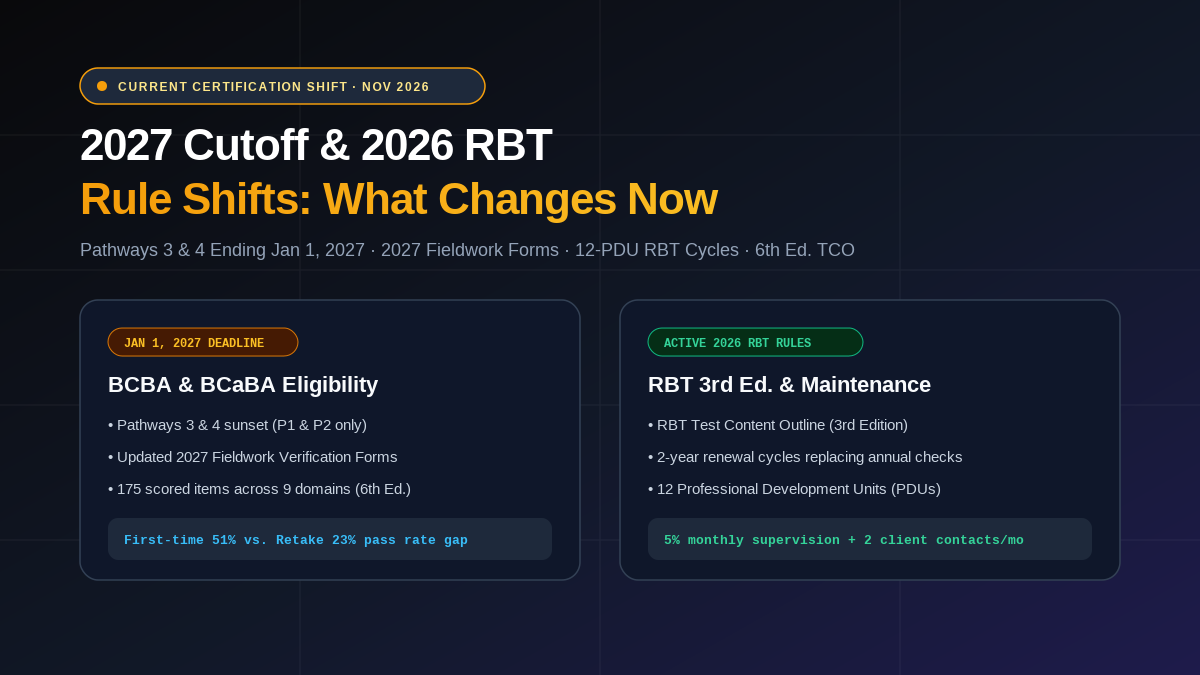
With January 1, 2027 weeks away, Pathways 3 & 4 end, new Fieldwork Verification Forms take over, RBTs transition to 12-PDU 2-year cycles, and the 6th Edition Test Content Outline reshapes how candidates pass.
Why Late 2026 Is a Critical Turning Point for ABA Candidates
Whether you are wrapping up graduate fieldwork hours or supervising technicians on the clinic floor, the final quarter of 2026 carries major structural deadlines across every tier of behavior analysis certification.
With January 1, 2027 just weeks away, two overlapping transitions are reshaping candidate strategy right now:
- BCBA and BCaBA eligibility updates taking effect January 1, 2027, including pathway closures and updated fieldwork documentation requirements.
- Ongoing 2026 RBT structural shifts, including the 3rd Edition Test Content Outline, two-year renewal cycles, and mandatory Professional Development Units (PDUs).
Understanding how these policy changes intersect with the current exam blueprint helps you avoid rejected paperwork, expired timelines, and unnecessary retakes.
1. The January 1, 2027 BCBA & BCaBA Cutoff: 3 Immediate Checkpoints
If your application will be submitted—or reviewed—in 2027 rather than before the end of December 2026, verify these three rules immediately:
- Pathways 3 and 4 Are Ending: Alternative qualification routes outside standard accredited degrees (Pathway 1) and verified behavior-analytic coursework (Pathway 2) sunset cleanly for applications entering under 2027 standards. Candidates who qualify solely under older alternative routes must finalize their documentation before the deadline rather than assuming grace periods will extend automatically.
- New 2027 Fieldwork Verification Forms (FVFs): Trainees submitting hours under 2027 criteria must use the revised Monthly and Final Fieldwork Verification Forms separating individual supervisors from multi-supervisor organizational teams. Using outdated 2022–2026 templates on a 2027 application triggers immediate administrative delays.
- Coursework & Unrestricted Hour Ratios: Double-check your unrestricted activity balance (minimum 60% for standard fieldwork) and verify that every monthly form was signed before the end of the following calendar month—retroactive signatures remain one of the top reasons audits fail.
Use our interactive BACB Fieldwork & Supervision Calculator to check your exact 5% supervision contact rate and unrestricted percentage before submitting your final packet.
2. What Already Changed for RBTs Across 2026
Technician certification is no longer an annual rote-memory formality. Three major shifts are active right now:
| Area | Earlier Model | Current 2026–2027 Standard | Clinical Impact |
|---|---|---|---|
| Exam Blueprint | 2nd Edition Task List | RBT Test Content Outline (3rd Ed.) | Stronger emphasis on assent, compassionate care & measurement fidelity |
| Renewal Cycle | Annual recertification | 2-Year Recertification Cycle (new 2026 certs) | Longer tracking window requiring continuous supervision logs |
| Continuing Education | No ongoing PDU tally | 12 PDUs per 2-Year Cycle | Ongoing formal skill maintenance in ethics, ASD & ABA delivery |
| Monthly Oversight | 5% + 2 contacts | 5% + 2 contacts (1 live client obs.) | Standardized monthly checklists audited strictly |
3. Why BCBA First-Time Pass Rates Dropped Near 51% (and Retakes Sit Near 23%)
Since the 6th Edition Test Content Outline took effect across 175 scored items (plus 10 unscored pilot items) spanning 9 clinical domains, candidates studying from 2020–2023 definition flashcards have been caught off guard. The numbers tell the story: first-time BCBA pass rates dropped to 51% while repeat candidate pass rates sit near 23%.
Here is what changed inside the exam stem itself:
- Neurodiversity-Affirming, Non-Deficit Phrasing: Exam questions actively penalize rigid, compliance-only answers when a scenario involves client assent, cultural values, or trauma-informed pacing.
- Domain Integration: You will rarely get an isolated terminology question. A single scenario tests whether you can diagnose a motivating operation (Domain B), select the least intrusive measurement system (Domain C), verify supervision integrity (Domain I), and defend social validity simultaneously.
- 45-Second Discrimination Under Fatigue: Two options look clinically reasonable; one contains a subtle scope-of-competence, measurement, or consent flaw.
If you are racing a test window before year-end or scheduling early 2027, run our free Board Baseline Calibrator and generate a tailored countdown schedule inside the Adaptive Study Plan before burning another attempt.
Practice Exam Scenario (Domain I & Supervision Standards)
Scenario: A trainee is accumulating concentrated supervised fieldwork hours at an organization where three different BCBAs co-supervise the client caseload. On October 28, the primary supervisor realizes she missed signing the trainee's August Monthly Fieldwork Verification Form due to clinic turnover, even though all session calendars and supervision notes exist in the electronic medical record. What is the most appropriate course of action?
- A. Have the trainee generate a single combined Final Fieldwork Verification Form and backdate August's monthly entry so hours are not lost.
- B. Ask one of the other two BCBAs at the organization to sign the August monthly form using October's date as a courtesy co-signature.
- C. Exclude the August hours from the official certification count unless properly executed timely documentation exists, and document corrective tracking moving forward.
- D. Submit August's raw EHR timesheets directly alongside an explanatory email during the final application audit.
Breakdown & Distractor Rationale
- A is incorrect: Backdating a Monthly Fieldwork Verification Form violates BACB documentation integrity rules and Domain I ethical standards regarding truthful representation of supervision records.
- B is incorrect: A supervisor cannot fabricate or retroactively certify a monthly period they did not synchronously supervise according to monthly tracking deadlines.
- C is correct: Timely monthly signatures (before the end of the following calendar month) are an explicit documentation requirement; unverified months cannot simply be backdated to salvage hours.
- D is incorrect: Raw EHR timestamps do not substitute for compliant monthly fieldwork verification forms signed within the required window.
Ready to test your timing on full 185-question blocks built for the 6th Edition outline? Launch a Free Timed Mock Exam or drill Domain-Specific Questions right now.
Master of Science in Applied Behavior Analysis (National University), active RBT with 3+ years of clinical fieldwork, and current BCBA candidate. Creator of ABA Mock Prep, bridging standardized board testing with real clinical practice.
Ready to test your speed on questions like this?
Jump into our timed board simulator with 1,000+ realistic scenario questions, 4-hour mock exam pacing, and instant AI tutor explanations for every distractor.