Unusual Case: Why a 'Polite 2-Minute Warning' Triggered Immediate Meltdowns (CMO-R & Countercontrol)
A calm learner exploded every time staff knelt down warmly with a visual timer—two full minutes before any demand started. Here is why Reflexive Motivating Operations (CMO-R) explain the paradox and why escape extinction backfired.
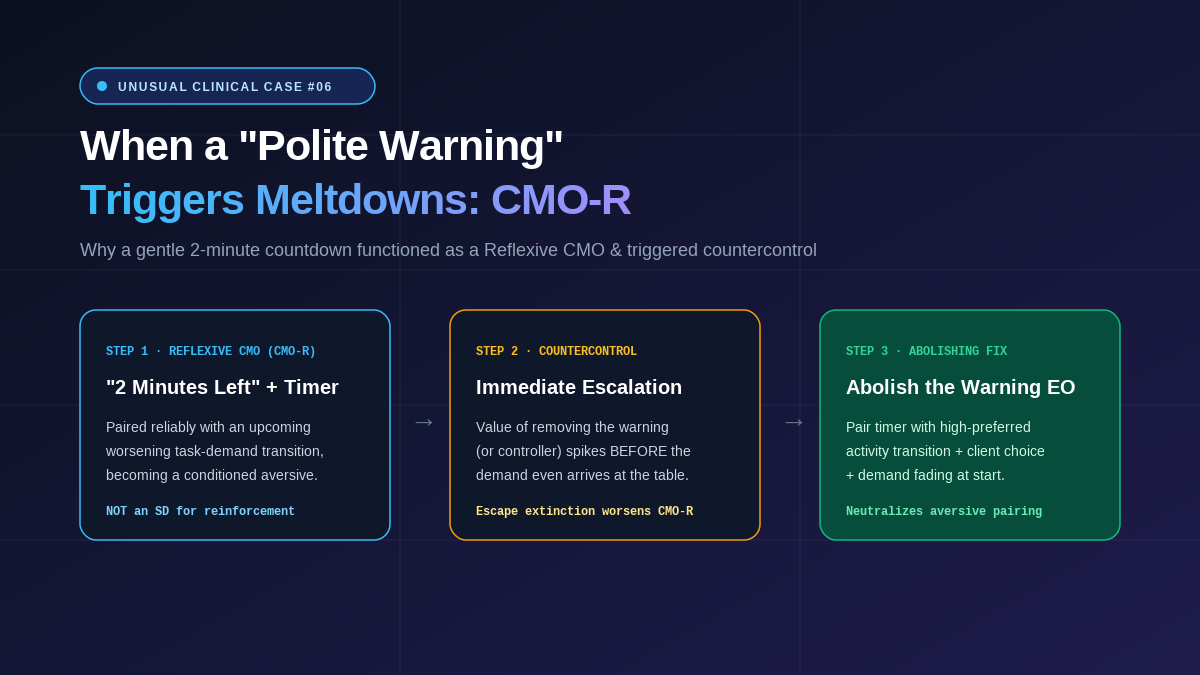
The Clinical Paradox: Escalation Triggered by Kindness Before Any Task Began
In clinical practice—and on higher-difficulty Domain B and Domain G questions—some of the hardest cases happen when a widely recommended "gentle transition strategy" makes behavior significantly worse.
Consider this real clinical presentation:
- Learner: Leo, an 11-year-old student with strong vocal language working in an afternoon clinic room.
- Observed Pattern: Whenever Leo was calmly playing with preferred building sets, his behavior stayed relaxed for 20+ minutes straight. Yet the moment a warm, well-liked therapist knelt beside him, smiled softly, held up a visual countdown timer, and said, "Hey buddy, two more minutes and then it's table work!", Leo screamed, swept the toys off the shelf, and threw the timer across the room.
- The Puzzling Part: Zero academic tasks were on the table yet. Two full minutes of preferred play remained. And Leo was not asking to keep building—he actively ran away from the play corner and tried to push the therapist out of the room.
Wait—why would giving a supportive countdown cause an immediate explosion even during preferred playtime?
Why the Team's First Two Hypotheses Failed
Hypothesis 1: "Sensory intolerance to timers or transitions"
When staff quietly removed the visual timer and just used a gentle verbal countdown without holding anything up, the exact same throwing and shouting occurred. The visual beep was not the trigger.
Hypothesis 2: "The warning functioned as an SD for escape—so just apply Escape Extinction"
Some team members argued: "He knows work is coming, so let's follow through immediately after the timer and block escape."
Result: Property destruction tripled across four days, and Leo began screaming the moment any therapist merely stood up from a desk holding a clipboard—even when no transition was scheduled. Why did escape extinction make the entire room toxic?
The Real Mechanism: Reflexive CMO (CMO-R) & Countercontrol
To decode what happened, distinguish Discriminative Stimulus (SD) from a Conditioned Motivating Operation – Reflexive (CMO-R):
- An SD signals that a specific behavior will be reinforced right now (e.g., an open juice bottle signals saying "juice" will get juice).
- A CMO-R is a stimulus that reliably precedes a worsening environmental condition (pain, sharp drop in reinforcement density, heavy unprompted demands). Because of that warning pairing, the CMO-R itself acquires conditioned aversive properties and establishes the value of its own termination!
Look at Leo's conditioning history:
- Over dozens of past sessions, "Two more minutes, buddy!" reliably predicted an abrupt drop from dense preferred play to high-error academic demands with frequent verbal corrections.
- Thus, the polite countdown did not simply remind Leo of time—it transformed into a CMO-R signaling "Things are about to get much worse."
- Because escaping the warning situation (or getting the presenter to back off) was the highest-value reinforcer at that exact second, any behaviors directed at removing the speaker and transition signal escalated immediately—a classic manifestation of countercontrol against aversive antecedent signaling.
When staff doubled down with immediate forced escape extinction right on top of the warning, they accidentally strengthened the aversive pairing of every therapist posture and voice tone!
Quick Exam Contrast: CMO-R vs. CMO-T vs. SD
| Concept | Establishing Mechanism | What It Signals / Alters | Typical Clinical Fix |
|---|---|---|---|
| CMO-R (Reflexive) | Signals an impending worsening condition | Establishes value of removing itself / warning cue | Abolish aversive transition: enrich target area, offer choice, fade demand load |
| CMO-T (Transitive) | Signals need for an intermediate tool/means | Alters value of an object needed to reach terminal SR | Teach functional mand for missing item/information |
| CMO-S (Surrogate) | Neutral event paired with an unconditioned MO | Evokes same effect as the UMO it matched | Recondition pairing with neutral/positive outcomes |
| SD (Discriminative) | Paired with availability of reinforcement | Signals response will work now (does NOT change value) | Alter prompt hierarchy or differential reinforcement |
value-altering effect), making it a CMO-R—not merely an SD!How the BCBA Solved It Using Abolishing Operations (Not Force)
Instead of arguing over countdown timers or locking down escape attempts, the BCBA neutralized the CMO-R itself:
- Abolished the aversive contrast at transition: The table area began every work block with 2 minutes of easy, errorless preferred activities (high-p sequence + embedded preference) BEFORE introducing academic demands.
- Delivered genuine choice & assent: The therapist offered a low-effort transition option ("Want to carry the blue folder or pick the chair first?"), stripping away aversive countercontrol contingencies.
- Reconditioned the countdown signal: Over 10 sessions, the 2-minute timer predicted a transition toward an equally high-value, supportive task rather than a sudden cliff into frustration. Meltdowns dropped to near zero without physical restraint.
Practice Exam Scenario (Domain B & Antecedent Interventions)
Scenario: Every weekday at 3:55 PM, a supervisor walks down the clinic hallway rattling her keys just before locking the sensory gym and escorting clients to clean up toys. Within two weeks, a client begins screaming and pulling staff hair the instant he hears keys jingling in the hall—even before the supervisor enters his room or issues an instruction. Behavior-analytically, what best describes the rattling keys?
- A. A conditioned stimulus eliciting purely respondent startle crying.
- B. A discriminative stimulus (SD) signaling that hair pulling will be reinforced with preferred gym access.
- C. A reflexive conditioned motivating operation (CMO-R) establishing its own termination and escape from the impending worsening transition as reinforcement.
- D. A transitive conditioned motivating operation (CMO-T) establishing the value of obtaining keys to unlock the gym.
Breakdown & Distractor Rationale
- A is incorrect: Hair pulling and screaming are goal-directed operant escape/countercontrol behaviors maintained by delaying or terminating the transition sequence, not unconditioned/respondent startle reflexes.
- B is incorrect: The keys were never paired with availability of gym reinforcement for pulling hair; they signaled an impending worsening event (gym closing).
- C is correct: Because the rattling keys reliably warn of an impending worsening condition, they function as a CMO-R, turning termination of that warning state (and avoidance of the transition) into a potent reinforcer.
- D is incorrect: A CMO-T requires a blocked chain where an item is needed as a tool to obtain a separate reinforcer already established by an active MO.
Test your grasp of MO traps and antecedent interventions in our BCBA Practice Simulator or practice visual & MO cases in Targeted Practice.
Master of Science in Applied Behavior Analysis (National University), active RBT with 3+ years of clinical fieldwork, and current BCBA candidate. Creator of ABA Mock Prep, bridging standardized board testing with real clinical practice.
Ready to test your speed on questions like this?
Jump into our timed board simulator with 1,000+ realistic scenario questions, 4-hour mock exam pacing, and instant AI tutor explanations for every distractor.